Tangles, directed by Leah Nelson and written with Sarah Leavitt and Trev Renney, adapts Leavitt’s graphic novel Tangles: A Story About Alzheimer’s, My Mother and Me into an animated biographical drama that turns a private family crisis into a delicate reflection on memory, care and the difficult work of remaining close to someone who is slowly becoming unreachable. After its world premiere in the Special Screenings section of the 2026 Cannes Film Festival, where it was also selected for both the Caméra d’Or and the Queer Palm, the film continues its festival journey at the Annecy International Animation Film Festival, where it screens in competition today, June 26. International sales are handled by Charades, confirming the film’s place within a circuit of auteur animation interested in intimate stories that ask for emotional attention.
The story follows Sarah, a young artist living in San Francisco, where her work, her relationship with Donimo and her everyday independence give her a sense of life that feels self-made and still in motion. That life is interrupted when her mother Midge begins to show the signs of Alzheimer’s, forcing Sarah back toward the small conservative town she had left behind. The return home is painful precisely because the film avoids the most predictable version of this conflict. Sarah’s family doesn’t reject her queerness, and her private life is not framed as an act of rebellion against them. What awaits her is more complicated and more ordinary: a family that loves each other, yet doesn’t know how to respond when illness begins to change the terms of every gesture, every conversation and every memory.
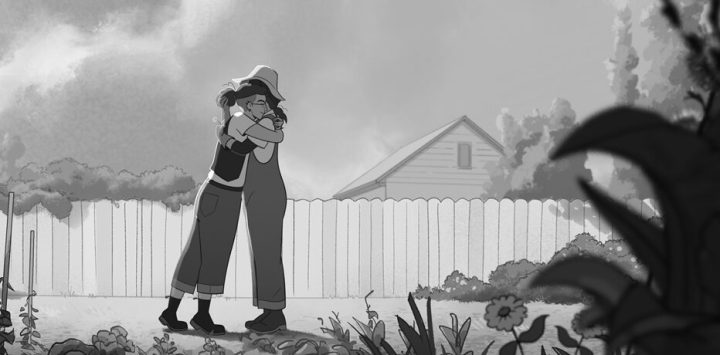
This is where Tangles finds its most convincing emotional ground. Alzheimer’s enters the film as a series of small displacements that make the familiar feel unstable. Midge forgets, misreads and remains herself at the same time, which is exactly what makes her decline so hard to bear. Julia Louis-Dreyfus gives the character a vocal presence that stays sharp and unpredictable, capturing the movement between affection, clarity and fear without reducing Midge to a symbol of deterioration. Abbi Jacobson’s Sarah is quieter and more contained, as though she were constantly trying to keep herself reasonable because collapse would be too easy. Bryan Cranston, voicing Rob, brings a more guarded kind of pain to the family dynamic, suggesting a man who can only face the diagnosis by making it softer and less final. Their scenes work because the film understands that caregiving isn’t made only of noble decisions. It’s also made of impatience, guilt and the shame that follows after a moment of anger. The director is especially good at showing how a diagnosis reorganises a family before anyone has found the words to describe what is happening. Rob softens the truth into something he can live with, Hannah turns exhaustion into sharpness, and Sarah often confuses urgency with clarity because action seems more bearable than waiting. Around Midge, love becomes awkward and sometimes selfish, made of missed signs, arguments and decisions that nobody feels ready to make. Each character chooses a different way to survive the same fear, and the film’s compassion comes from watching those strategies fail without treating failure as a moral verdict.
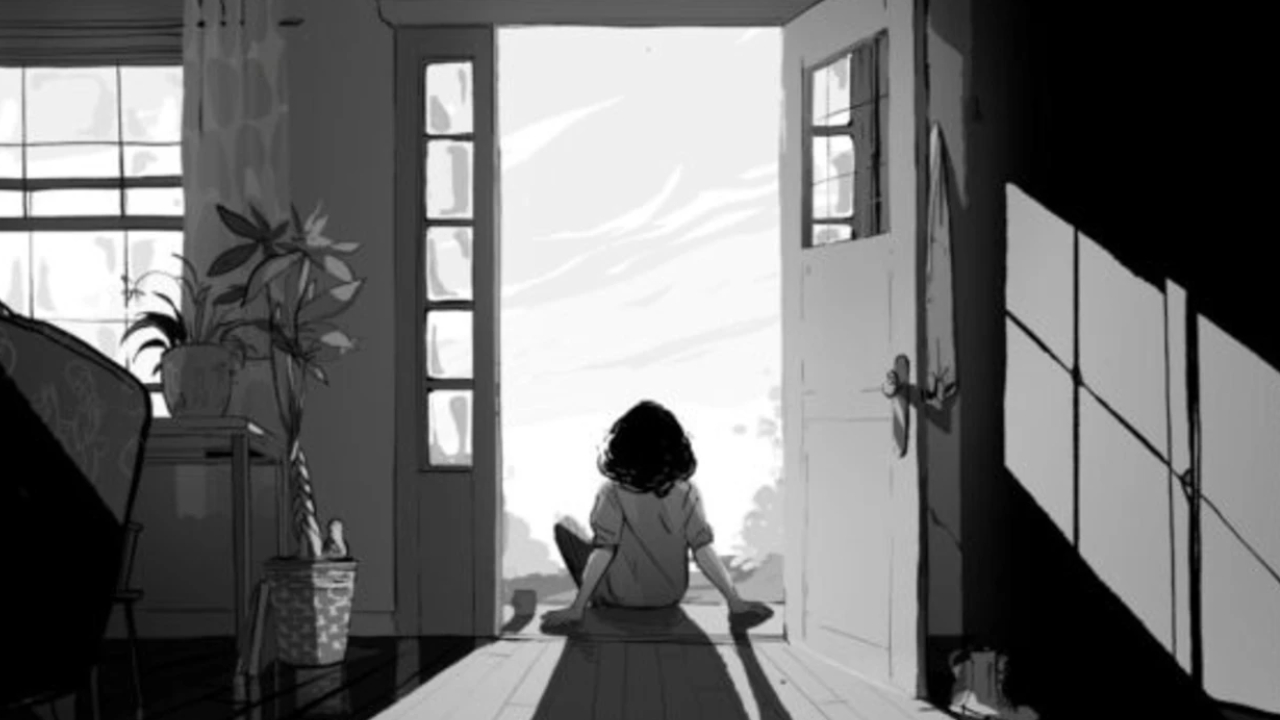
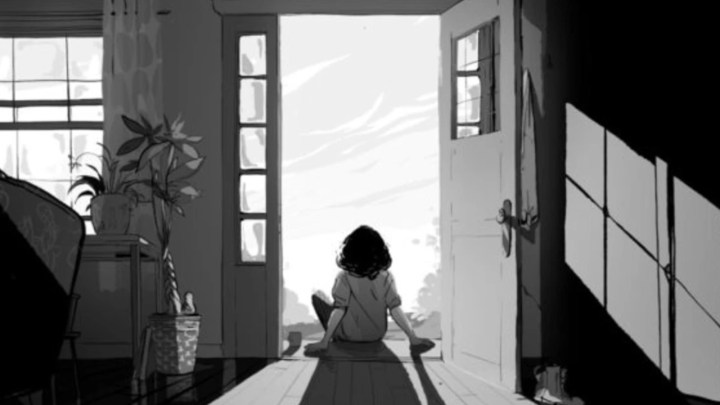
For a film built around such painful material, even a small moment of lightness requires real psychological control, and this is one of the places where Leah Nelson shows a precise understanding of tone. The lighter moments come from the strange behaviour people adopt when they are frightened and still trying to act normal, like a misplaced joke or a stubbornly hopeful interpretation. Tangles recognises that even in the middle of decline, a family doesn’t stop being messy, contradictory and alive. Midge’s decline is devastating, yet life around her continues to produce embarrassment, tenderness and strange little bursts of vitality. Sarah’s lesson isn’t simply that she must accept loss. She also has to understand that loss doesn’t erase everything around it. The animation is central to that idea. It unfolds in black and white with a stripped visual texture that seems to place the story somewhere between memory and sketchbook. The choice suits Sarah’s perspective, since the world is filtered through an artist who is trying to make sense of experience by turning it into lines, faces and fragments. The rare intrusions of colour, especially those sudden flashes of magenta and violet, feel like emotional residues rather than meaningful, as if something too intense to disappear had briefly forced its way back into the image. At times, I did wish the film had trusted those eruptions more often, because they suggest a more adventurous visual language that only appears in fragments.
The film becomes most alive whenever Sarah’s perception starts to reshape the world around her. These are the moments in which Tangles stops asking animation to accompany the story and lets it do the work that no other form could do as directly. A street full of people can suddenly feel hostile and unreadable, a simple medical exercise can open onto the frightening geometry of a mind under pressure, and Sarah’s private fears can take on a physical presence before she has found the words for them. Nelson’s best visual ideas come from this refusal to keep illness in the realm of explanation. That is also why the film can be placed beside works such as Persepolis (2007) and Flee (2021), where animation becomes a way of shaping lived experience, giving memory and subjectivity a form that feels inseparable from the story being told. Tangles is smaller in scale, yet it shares their understanding that drawing can hold together fact, memory and emotional distortion without forcing them into a single stable version. A live-action adaptation might have preserved the family drama, especially with these performers, but it would have struggled to express the most important thing about Sarah’s point of view: she doesn’t simply remember through images, she survives by making images. The film’s real subject is therefore not only Midge’s disappearance into illness, but Sarah’s attempt to give that disappearance a shape before it becomes impossible to grasp.
Tangles is strongest when it remains close to Sarah and Midge, where every hesitation and small act of care carries the weight of a relationship being rewritten in real time. Some secondary figures are drawn with a broader hand, yet the emotional core holds firm, confirming Leah Nelson’s feature debut as a remarkable achievement in almost every respect. The film also belongs to a broader queer wave in contemporary cinema, where identity can shape a life without becoming the only conflict that defines it. In the end, Tangles finds its force in what remains after memory begins to fail: the fragments a daughter tries to save, the imperfect love that survives fear, and the images that can still hold a person when recollection starts to disappear.


